
BE FAST - recognize a stroke! 🧠
An explainer on how to recognize and respond to an episode of stroke at the earliest.

Hello, and welcome to Reflections, my personal newsletter. I'm Sanuj, an internal medicine physician. I write about health, wealth and family. If you're new here, you can learn more about Reflections in the about page. If you would like to read more and receive regular, weekly posts, hit the subscribe button below.
We all know someone who has experienced a stroke. Familiar presentations include a face that is shifted to one side, a weakness and inability to perform familiar tasks one side of the body, and speech difficulty. In fact, stroke is the second most common cause of mortality and disability worldwide1. The lifetime risk for an adult to land up with a stroke is 25 per cent2, which is no small number.
Although strokes have risks of mortality and disability, there are certain kinds of strokes that can be reversed if diagnosed and treated on time. This window of opportunity to reverse the episode of stroke is so narrow that many who could've benefited from a timely intervention arrive late at a hospital with a well-established stroke management facility.
So, in this medical awareness post, I share the basics of a stroke and how to recognize it at the earliest.

What is a Stroke?
A stroke is a medical emergency. It is a disease that affects the arteries that supply blood to the brain. In the words of the American Stroke Association,
A stroke occurs when a blood vessel that carries oxygen and nutrients to the brain is either blocked by a clot or bursts (or ruptures).
This leads to damage to the brain cells in the area supplied by that blood vessel resulting in neurological manifestations such as one-sided weakness, blurring of vision, deviation of the side of mouth to one side, difficulty in speech, memory disturbances, loss of consciousness and even death. A stroke is to the brain what a heart attack is to the heart.
The brain has specific areas that corresponds to a neurological function of the body. For example, one area of the brain is the centre for speech and another area is specialized for understanding speech. In the same way, one area of the brain controls the upper limb while another area controls the lower limb. The presentation of a stroke patient, therefore, depends on the area affected.
Types of strokes
Although there are many classifications and sub classifications of stroke medically, what’s important is to know that there are two broad divisions of the types of strokes.
Ischemic - a blood clot obstructs the blood vessels that supply the brain, and
Haemorrhagic - a ruptured blood vessel causes a bleed around the brain cells.
Roughly 80 per cent of stroke presentations are of ischemic origin. That is a relief because some of the ischemic strokes, unlike haemorrhagic ones, are completely reversible if the patient presents within the therapeutic window period to a well-established stroke management centre at a tertiary or quaternary care hospital.
In other words, the neurological presentation associated with a stroke (such as limb weakness, speech disturbance, etc.) can be cured if the patient arrives within the window period, provided the underlying cause of stroke is eligible for reversal therapy.
The Golden Window Period
One way to reverse the effects of potentially reversible ischemic thrombotic strokes is to administer a clot dissolving medicine intravenously. The window period to receive this injection is 4.5 hours from the onset of the stroke, after which no benefit is seen.
The other way is to perform an invasive procedure via a blood vessel in one of the limbs to extract the blood clot from the culprit blood vessel in the brain. This is a non-surgical procedure and should be done within 24 hours. However, clot extraction can only be done in one of the larger arteries supplying the brain. The smaller arterial branches are relatively inaccessible.
Both these methods require a trained and specialized stroke management team to execute them. This facility is not universally available. It's best to find out in advance which is the nearest hospital that provides these services so that one does not waste any time in moving a patient to such a hospital.
Learn to recognize a stroke with this mnemonic
Here is an easy to understand and quick to recall mnemonic to recognize and respond to the signs of stroke - BE FAST.
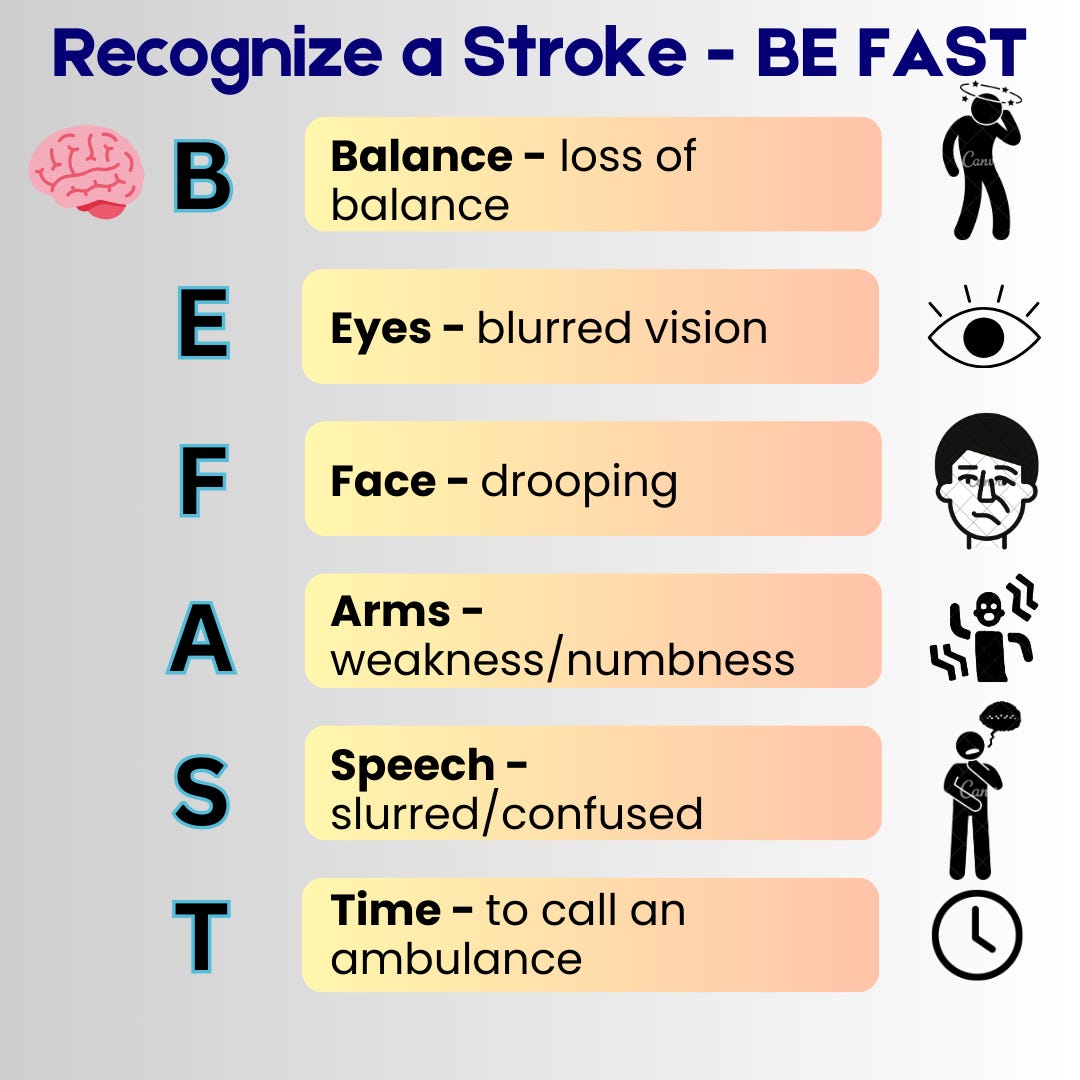
The next time you see a person experiencing imbalance, visual complaints, drooping of one side of the face, weakness of limbs, or slurred speech, call an ambulance immediately, because every minute delayed decreases the chances of a stroke reversal and increases the risk of permanent disability or death.
So, the next time you recognize a stroke, call 108 (in India)/911 (in USA) immediately. Remember, time is brain!
This post is for educational purposes. Recognizing a stroke may prove valuable in saving the life of a patient. I urge you all to share this post with as many people as possible to raise awareness.
GBD 2016 Neurology Collaborators. “Global, regional, and national burden of neurological disorders, 1990-2016: a systematic analysis for the Global Burden of Disease Study 2016.” The Lancet. Neurology vol. 18,5 (2019): 459-480. doi:10.1016/S1474-4422(18)30499-X
GBD 2016 Lifetime Risk of Stroke Collaborators et al. “Global, Regional, and Country-Specific Lifetime Risks of Stroke, 1990 and 2016.” The New England journal of medicine vol. 379,25 (2018): 2429-2437. doi:10.1056/NEJMoa1804492
Thank you Sanuj for this crucial message and advice; which everyone will benefit! A loved one had stroke and I was lucky to be there and sent him to the hospital within the golden window; he had the invasive procedure to take out the blood clot, and he walked out almost unchanged as before after a few days. Thank God!
Great information to keep on hand! Thank you so much for sharing Sanuj! 🤗💫💞
My uncle suffered from a terrible stroke years ago. He lived alone and it was a few days before a friend found him. He survived, but it haunts me when I think if him kyingbon the floor alone helpless for a few days.
I know where I live I doubt there is a stroke management facility within a shirt drive. Our loved ones would have to go to Los Angeles I think. I will have to do more research. What is the timeframe between when a stroke starts and when it can be reversed? Within a few hours? Or within a day? Thank you!